
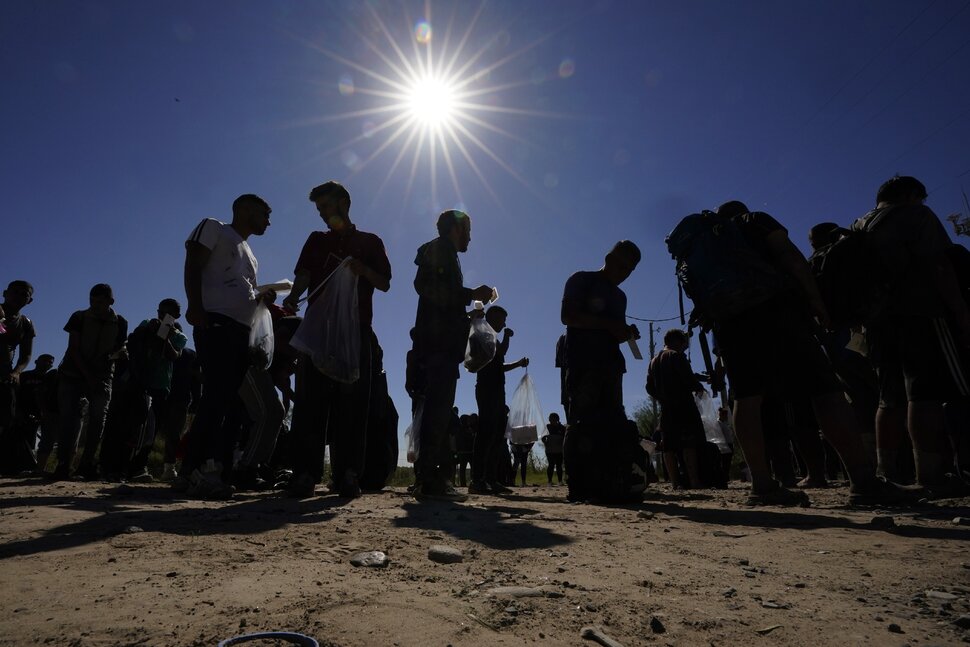
As Congress negotiates a deal to address the unprecedented level of attempted southern border crossings, data compiled by researchers at Syracuse University highlights just how big the backlog has grown at immigration courts – and which states are home to the most cases.
READ: Congress Careens Toward Border Showdown
The number of pending immigration court cases in the United States rose to more than 3 million in November 2023, setting a new record, according to the university’s Transactional Records Access Clearinghouse. The backlog grew by a million cases from December 2022 to November 2023. For reference, the backlog went up by about 50,000 cases from fiscal years 2013 to 2014.
“Immigration Judges are swamped,” reads a report from TRAC, which notes that judges now average 4,500 pending cases each. “If every person with a pending immigration case were gathered together, it would be larger than the population of Chicago, the third largest city in the United States.”
Florida and Texas have, by far, the largest immigration case backlogs, according to the research institute. Florida is home to 454,434 pending cases as of November 2023, while Texas has 426,901. The states with the next-biggest case loads are California, New York and Illinois. Across all states, the nationalities most represented in pending cases are Venezuelan, Mexican, Honduran and Guatemalan.
The states with the largest immigration court backlogs, according to TRAC:
- Florida: 454,434
- Texas: 426,901
- California: 327,743
- New York: 322,021
- Illinois: 192,044
- New Jersey: 176,104
- Massachusetts: 144,721
- North Carolina: 119,025
- Georgia: 117,861
- Tennessee: 111,894
Related: Fueled by Unprecedented Border Crossings, a Record 3 Million Cases Clog US Immigration Courts
Because of how the U.S. immigration system works, states have really no control over how many pending cases they have, according to Austin Kocher, a research assistant professor with the Transactional Records Access Clearinghouse. Immigration courts, which are within the Department of Justice, are responsible for adjudicating immigration cases involving noncitizens generally who have been charged by the Department of Homeland Security with being in violation of immigration law. Judges resolve questions such as whether an individual should be allowed to remain in the U.S. or whether an individual’s application to avoid deportation – an asylum request, for example – should be granted, according to the institute.
Volkswagen Group Africa’s Contact Centre Transformation
There are about 70 courts across the country and not every state has one. There are also immigration courts in some U.S. territories, such as Puerto Rico and Guam, and they have smaller backlogs than most states as of November 2023.
Kocher says just because a noncitizen who arrives at the southern border might have their case assigned to a court in Texas, nothing stops them from moving to another city and “living there until their hearing comes up.” But he notes that Miami has the largest number of pending cases among cities, and the size of a state’s or city’s backlog generally correlates to where migrants want to be, at least temporarily.
READ: States Restricting Gender-Affirming Care
“Those cases are there because … by and large, those people have decided that’s where they want to live while their case is pending,” Kocher says.
The states with the smallest immigration court backlogs, according to TRAC:
- New Mexico: 173
- Hawaii: 741
- Nevada: 16,179
- Michigan: 20,825
- Arizona: 23,132
- Oregon: 27,428
- Minnesota: 35,443
- Utah: 35,756
- Nebraska: 37,190
- Missouri: 37,735
There’s indeed a lot of “systemic pressure” on immigration courts, Kocher says. Because of the size of the backlog, there are many people with cases in courts who “may not even actually have a hearing,” he says, adding it’s a “sad” reality for people who need protection.
There is, though, a more positive spin to the size of the backlog. Kocher notes that it illuminates the fact that there is a legal process “and that people are going through it.”